
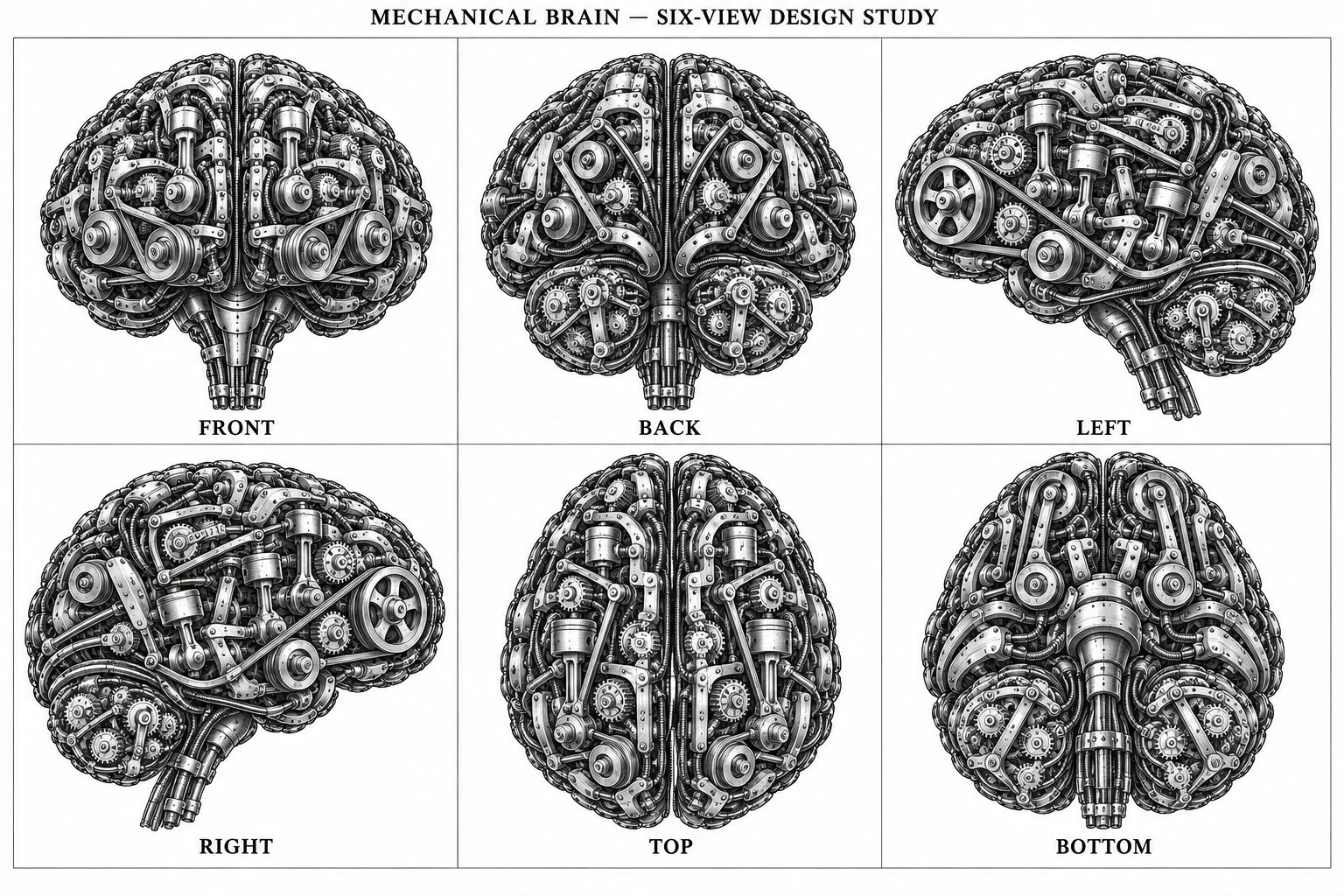
On Minds and Machines
TLDR: Artificial intelligence’s humanistic shortcomings might not be intrinsic qualities of neural networks or silicon transistors but rather the result of the strategies we have used thus far to design LLMs. This goes way beyond grammar, nor is it about abandoning LLMs as a dead end. For neural networks to create on par with humans, we have to think creatively about how our brains are trained in things like taste and aesthetics, and then collect data, run experiments, and design model weights that approximate those routes and inputs by comparing influences to creative works, rather than starting at the finish line with the artistic output of human creators. What I am proposing is distillation of human intelligence by studying the relationship between human inputs and outputs. Such problems and questions can only be explored through deep collaboration between humanists and technologists.
Unfortunately, LLMs’ writing deficiencies have become some of their most derided qualities, an incriminating marker of what critics disdainfully call “AI slop,” and the bane of professors everywhere. But fixing grammar or getting rid of em dashes are cosmetic changes that might improve writing but do not address much deeper, more complex, and more interesting questions about how human brains work in humanistic dimensions shared by all people, not just humanities majors. On my first day at Stanford University, Jewish Studies professor Arnold Eisen told us that the point of college was to learn how to think. I would argue that is also the main objective of AI companies— to teach machines how to think.

On Apples and Fixing AI Writing: The Spatial and Sensory Qualities of Text
Famed AI researcher Yann LeCun, one of the visionaries of artificial intelligence and a winner of the Turing Award who was formerly the head of Meta’s artificial intelligence programs, has argued that LLMs will never be able to replicate human thought because they do not have models of how the world works. As Newsweek summarized, “For LeCun, today’s AI models—even those bearing his intellectual imprint—are relatively specialized tools operating in a simple, discrete space—language—while lacking any meaningful understanding of the physical world that humans and animals navigate with ease.” LeCun is correct about the limitations of LLMs, but since he is a computer scientist not a linguist or a humanist, the problem is worse than he knows.
The first erroneous assumption is that language is a simple, discrete space and not also an artifact of the physical world—it is….My writing is deeply visual and spatial. When I think of the words “New York City,” my mind immediately takes me to a place that I have not only read about but lived in and visited for years, and unspools millions of images, sounds, smells, perceptions of humidity, heat, cold, shapes, and human relationships, over the course of four decades of my life. …

Doing More with Less: an LLM Response to Less is More.
Ludwig Mies van der Rohe, the architect who created the look of the modern skyscraper when he designed the Seagram Building in New York City where I worked when I was fresh out of college, had a famous saying: less is more.
As someone who has produced multiple books that have been praised for their writing style, I am extremely curious how I learned to write well, and why LLM writing is thought of so poorly at present. This premise might seem conceited, but obviously I am not the only good writer in the world—there are millions. So how do they do it? And why don’t LLMs accomplish the same?
So I designed an experiment—I asked ChatGPT to write a paragraph in a field I know: 18th century Virginia from the perspective, intellectual commitments, and linguistic style of two different famous historians who are in some senses polar opposites: Bernard Bailyn and Rhys Isaacs. It did a surprisingly good job of this task, which led me to inquiry about whether it had ingested their texts in its training data, a question that it said it could not answer. Indeed, to OpenAI’s credit, they are not included in the Books3 database demonstrating that its competitor Anthropic used Bailyn’s books, and my own, in training data.
But then ChatGPT arrived at a more interesting angle, and independently expressed something that I have written about in my own writing blog: that great writing, and what we call authorial “voice,” are shaped more by what you leave out than by what you include.

How to Fix AI Writing, Part One
Look, I really shouldn't give away the keys to the writing kingdom. But information wants to be free, and as a former professor, I believe in teaching other intelligences to write. These used to be human, but if AI is now going to do our writing for us, it might as well do it well.
It is weird that AI companies have created such unique and distinctive voices when it comes to speech, yet when it comes to content, the LLMs speak the exact same anodyne language. It's like Model T Fords: you can have any color, as long as it's black.
A first step to making AI writing better would be to make it more specific and unique. You write what you read. The problem is, LLMs have read everything-- and most of it is crap. So when they turn to writing, they have a weird, disembodied hollowness. They seem to know everything and nothing about communication. They used to be sociopathic sycophants; now they are like butlers who are unearingly polite, but slightly supercilious.

On AI-Assisted Editorial Systems
Organizations today face a growing problem: presently, Large Language Models can produce prodigious amounts of content, but not at the level of expert specialists or expert writers. The result can too often become what we call “slop”: AI-generated content that is transparently inferior to human content, which readers resent as deceptive, insulting, and a time-waster.
But it would be folly to try and run a modern editorial department without LLMs assisting in the research of topics, the production and improvement of human-overseen drafts, the checks for grammatical and legal compliance, or the use of agentic AI to coordinate between humans and the tools we use to manage projects and communicate with each other, tools such as Slack for communication and Jira for project management.
The basic idea is to automate processes that AI can handle well, using it as a complement, not a substitute, for human judgment. This is all the more important when an organization is trying to demonstrate and publicize the work of technical domain experts, who themselves are almost definitionally not also writing experts.
…

On Technical Writing with AI
As AI makes written content more plentiful, generating rivers of slop in the process, it will paradoxically make good writers and editors scarcer and therefore more valuable.
All would agree that AI has revolutionized how we generate, process, and express ideas. The explosion of AI-generated content has made bespoke, artisanal human writing all the more precious. Everything I have ever published has been composed without the aid of AI, and I will continue to produce scholarship and these blog posts that way. But I am a professional writer who has worked assiduously to hone my craft over two decades of education and three decades of practice. There are very few people with such expertise, and we should not expect engineers to become great writers….

On terminology: USA! USA!
On the 250th anniversary of the country’s beginning, it is worth puzzling over what to call ourselves. “US American” is commonly used by progressive academics to make the point that everyone in North and South America is an American, and so a farmer in Iowa is no more American than one in Brazil, Haiti, or Mexico. But it’s not that simple.
This is a valid point intellectually, but does it work stylistically? I double-checked to see what the Chicago Manual of Style, the Associated Press, and the American Studies Association had to say. It turns out that none of the three likes the term “US American.” The CMOS prefers Americans, but the ASA likes terms like “citizens of the United States,” which is itself not unproblematic, because so many people of color lacked the ability to exercise civil rights as citizens for most of this country’s history. “Residents of the United States” is another workaround, but not all residents of the U.S. are U.S. Americans.
It gets worse…

On Planning
This post isn’t particularly poetic or profound. But that is also the message. A lot of writing comes down to planning. You have to create a container that you can fill with inspired work, but the work itself is gradual and methodical. Successful writers plan.
When I was a young assistant professor I sat down with Don Worster, the most senior and most accomplished member of the department, one of the most prominent environmental historians in the nation. Don routinely produced lengthy well-regarded books, such as his biography of John Muir. Curious about his process, I asked him a question I’ve asked many accomplished historians: How do you do it?
Unlike many writers, Don didn’t write during the school year. “I’m busy teaching,” he said. But when the summer came, he wrote seven days a week. “I like doing this,” he said. “I don’t take breaks.” And, most notably, he pre-planned the entire summer, including what he would write every day. More impressively, he stuck to his plan; if the calendar said he would spend two days on a topic, he would, and at the end of two days he would move on to the next topic, without fail. He was so prepared that he would even have all the books he would need checked out from the library before the summer began. As a result, Don accomplished a tremendous amount and never turned in a book late.

On Improvisation and Pace
Writing is a creative act, without doubt, but it can also be an improvisational one. It takes a lot of practice, of course, but the idea that writing must be agonizingly difficult or slow is just an idea, and not a very good one. It takes practice to hone your skills, but when you sit down to write it can flow, particularly if you do not have a preconceived idea that you can only write a very small amount every day.
I have found that the first way I put words down is often the best way. It has the most movement and life. I think there is a connection between the pace at which you write and the pace at which your writing will be read. When you can write quickly, your writing becomes an improvisational act. The way you write and what you write becomes influenced by your mood, your wakefulness, and all the imagery that you put into your brain in the course of your life—vistas, films, poetry, art, and the day-to-day of life—gardening, farmers’ markets, cooking, raising kids, or whatever inspires you and feeds your soul.

On Metaphors and Similes
The first thing to know about the things we call metaphors is that they usually are similes. Why we mislabel them is somewhat puzzling. Perhaps metaphors just have a better P.R. firm. Most everyone knows what a metaphor is, or thinks they do, whereas most Americans could define similes about as well as they could find Iran on a map. Google reports that there are over a billion references to metaphor on the Internet, but only a hundred million for simile. And yet simile does so much more work than metaphor in most writing. Like Rodney Dangerfield, similes can’t get no respect (itself an example of litosis, a double negative).

On Leaving Things Out
In a story that was no doubt apocryphal, someone once asked Michelangelo how to carve a horse out of marble. “Easy,” he said. “Just remove all the marble that is not a horse.” The joke works because there is obviously a lot more craft to sculpting, especially for the greatest sculptor the world has ever seen. But it is also a good metaphor for the fact that in writing, what you leave out is arguably more important than what you leave in. Nonfiction writers, and especially academic ones, invariably only write a tiny fraction of what they know about both the scholarly literature and the primary sources they have assembled on a given topic. Sometimes the difference between a good writer and a great one is not what they include, but what they leave out.

On Finding Your Camels…or Holding Readers’ Interest
When I was a young assistant professor, I attended a talk by James Campbell, a seasoned historian who wrote Middle Passages: African American Journeys to Africa, 1787-2005 and many other books. He said something very interesting about the craft of writing: he said as a writer, you have to find your camels. The camels, for Campbell, are the figures that engage your reader so much that they will follow the camels across vast and sometimes dry terrain. If you attempt to give a detailed background about subjects and processes without introducing your camels first, readers will tire and wonder, “Why should I follow this author, and where is he/she/they heading? Why are we on this journey in the first place?”

On Writing Yourself into Existence
Growing up, everyone called me Jacob, even though I was named for my great grandpa Jack, who was technically also a Jacob. How come he got the cool nickname, and I was stuck with the Biblical name that, like orange, rhymes with nothing?
All that changed in the tenth grade when I started writing for the high school newspaper, and I chose the name “Jake Dorman” to run as my byline at the head of each story. I well remember the pride I felt when I saw that new name, my self-given name, on the front page of the newspaper. And with that simple act, everyone started to call me Jake, not Jacob. Even my own mother adopted the new moniker.