
On Finding Your Camels…or Holding Readers’ Interest
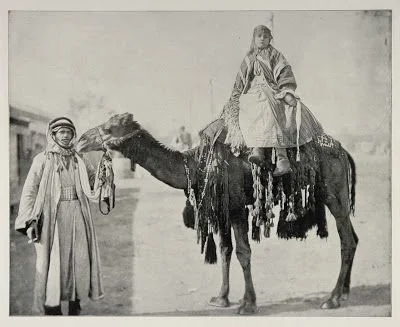
When I was a young assistant professor, I attended a talk by James Campbell, a seasoned historian who wrote Middle Passages: African American Journeys to Africa, 1787-2005 and many other books. He said something very interesting about the craft of writing: he said as a writer, you have to find your camels. The camels, for Campbell, are the figures that engage your reader so much that they will follow the camels across vast and sometimes dry terrain. If you attempt to give a detailed background about subjects and processes without introducing your camels first, readers will tire and wonder, “Why should I follow this author, and where is he/she/they heading? Why are we on this journey in the first place?”
That one piece of advice helped me greatly to structure my first book, Chosen People: The Rise of American Black Israelite Religions (Oxford University Press 2013), which won three book awards. I realized that I had fascinating people to write about. I knew that the book would be roughly chronological, but I had not thought through how I would draw readers through the story. There would be lots of arid land: I was writing a “micro-history” of very small religious movements, such as the offshoot of the Holiness Movement—the origins of the “holy rollers” and the “saints” who came marching in, and who led to the outbreak of Pentecostalism, the Christian revival movement whose members gave divine sanction to “speaking in tongues,” or glossolalia. The Pentecostal movement is quite large, massive in fact, but getting readers outside the Pentecostal church to care about it was a challenge. Getting them interested in the small number of Whites and Blacks who cosplayed the ancient Israelites by dressing up in Bedouin robes was an even bigger challenge. I had to find my camels.
And so, instead of writing an intellectual history that meandered across time and place with little to draw in readers, I chose four influential ministerial leaders and organized each chapter around them. The early figures included Charles Parham, one of the founders of Pentecostalism, William Saunders Crowdy, the African American minister who created the first Holiness church that preached that the ancient Isrealites were Black, Rabbi Arnold Josiah Ford, the Barbadian-born musician who created one of the first Judaic versions of Black Israelism, and Wentworth Arthur Matthew, the student of Rabbi Matthew’s who further developed Black Judaism and exported it across the United States. I had found my camels.
Now, instead of beginning each chapter with long passages of context and world-making, I focused on each of these men, and strung together everything that I could find about their lives—which was sometimes difficult because the historical record was quite sparce. But by tracking down census data, lists of immigrants coming off ships, rare newspaper mentions, and a few scattered archival collections, I was able to come up with enough about the figures and their times to draw readers in. I could then introduce extensive context about subjects that would have otherwise been so varied as to feel disconnected or extraneous, including the history of freemasonry, the Anglo-Israelite movement, the effort to found all-Black towns in Oklahoma, the Holiness and Pentecostal movements, and the Harlem Renaissance. In a way, it was a ruse, or a kind of magic trick of misdirection: care about these figures, learn about their times, and oh—by the way—learn quite a lot about often obscure topics.
I guess in a sense you could call literary camel-riding as a form of edutainment, a term that is frequently used somewhat derisively to describe television programs and the like that are neither very educational nor very entertaining. But as a form of sleight-of-hand it worked, or at least it worked well enough to allow that book to win awards and go through multiple printings. After all, our writing should be entertaining, and if your subject is not, or if your presentation of your subject is a little dry, it is worth thinking about how you will draw your readers in, and then lead them across the desert like camels across the Sahara.
Finding your camels is especially important for academic writers, who often write books aimed at narrow audiences with little effort to interest laypeople. You don’t have to find people to be your camels. One can well imagine other “camels,” such as a particular book, play, idea, or theme that reappears in multiple contexts. Scientists tell stories in scientific papers as well, usually about how something works, develops, or causes reactions. If you describe such things with sufficient enthusiasm, with a twinkle and a sense of wonder, you can animate even the inanimate—the upswelling of mountains, the drift of continents, the orbits of electrons, the idea of liberty, democracy, or equality. Since humans are innately storytelling animals, our brains are wired to personify and animate even the inanimate.
When you find your camels, readers will follow you anywhere.
Photo: American Alice Rainey with her new Lebanese husband and his camel at the 1893 World’s Columbian Exposition. See: The Princess and The Prophet.
