
Jacob S. Dorman, Ph.D.
Portfolio - Safety Transparency Editor - OpenAI

Alamy Images.
-
Executive communications: Prepared presentations, speeches, reports, grant proposals, newsletters, annual reports, executive correspondence, and donor communications for nonprofit organizations, foundations, and a Stanford University research institute.
Editorial leadership: Designed editorial processes, revision workflows, style guides, quality standards, editing checklists, and review procedures to improve consistency, quality, and efficiency.
Writer coaching: Mentored hundreds of undergraduate and graduate writers over seventeen years as a university professor through one-on-one coaching, workshops, and developmental editing.
Professional authorship: Published three award-winning scholarly books and more than a dozen peer-reviewed articles, translating complex research into clear, engaging prose for diverse audiences.
Analytical writing: Evaluated complex evidence, synthesized large bodies of research, constructed evidence-based arguments, and communicated nuanced conclusions to expert and general audiences.
AI-assisted writing and editing: Integrated large language models into editorial workflows for research, drafting, summarization, revision, style consistency, and quality assurance while maintaining rigorous human editorial oversight.
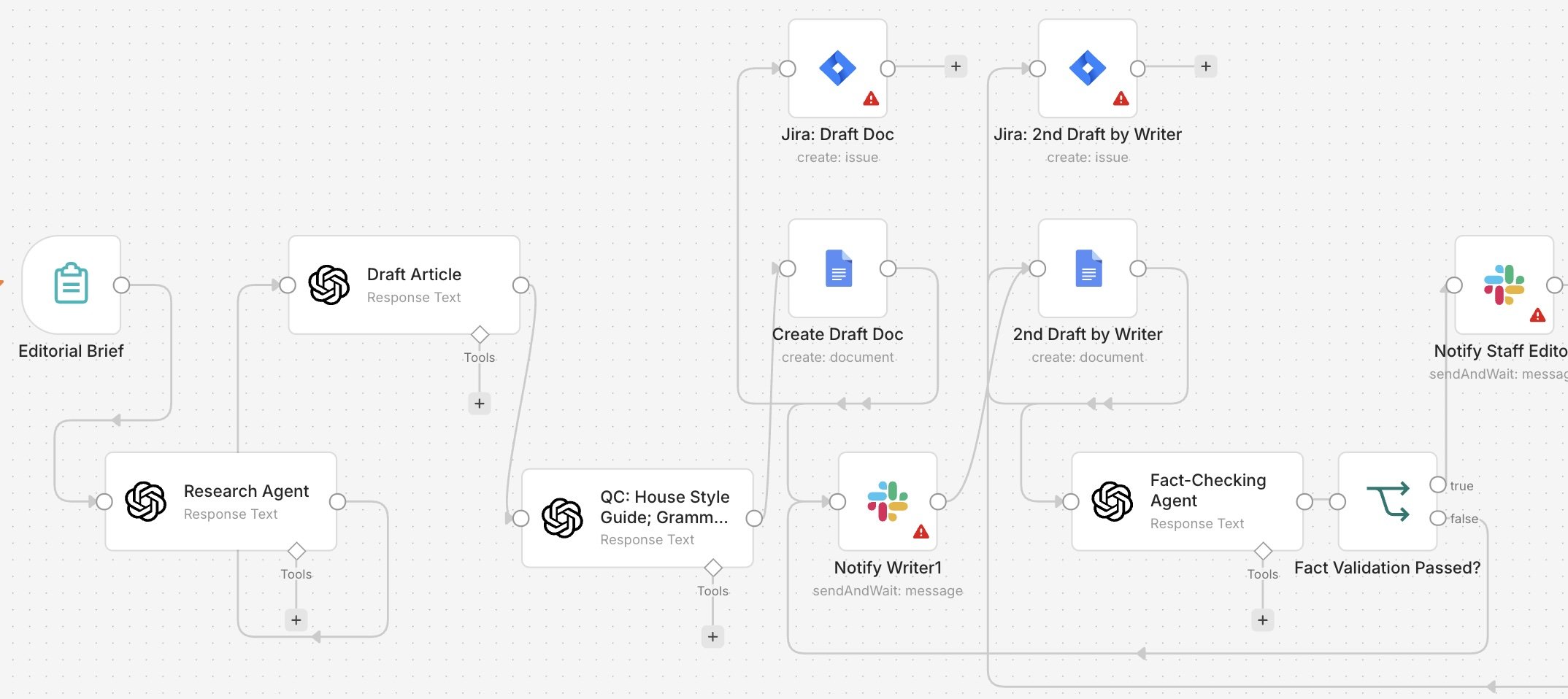
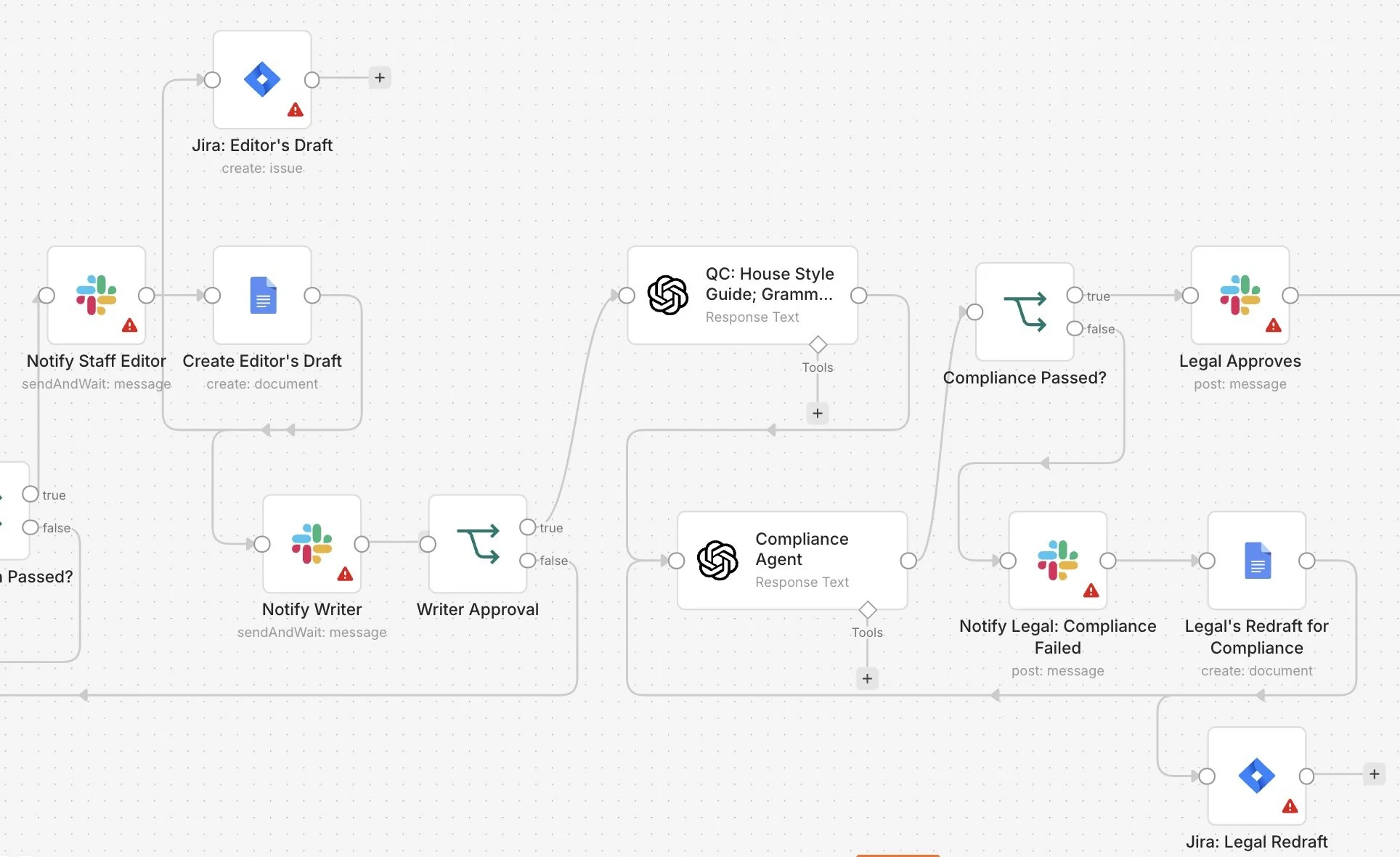
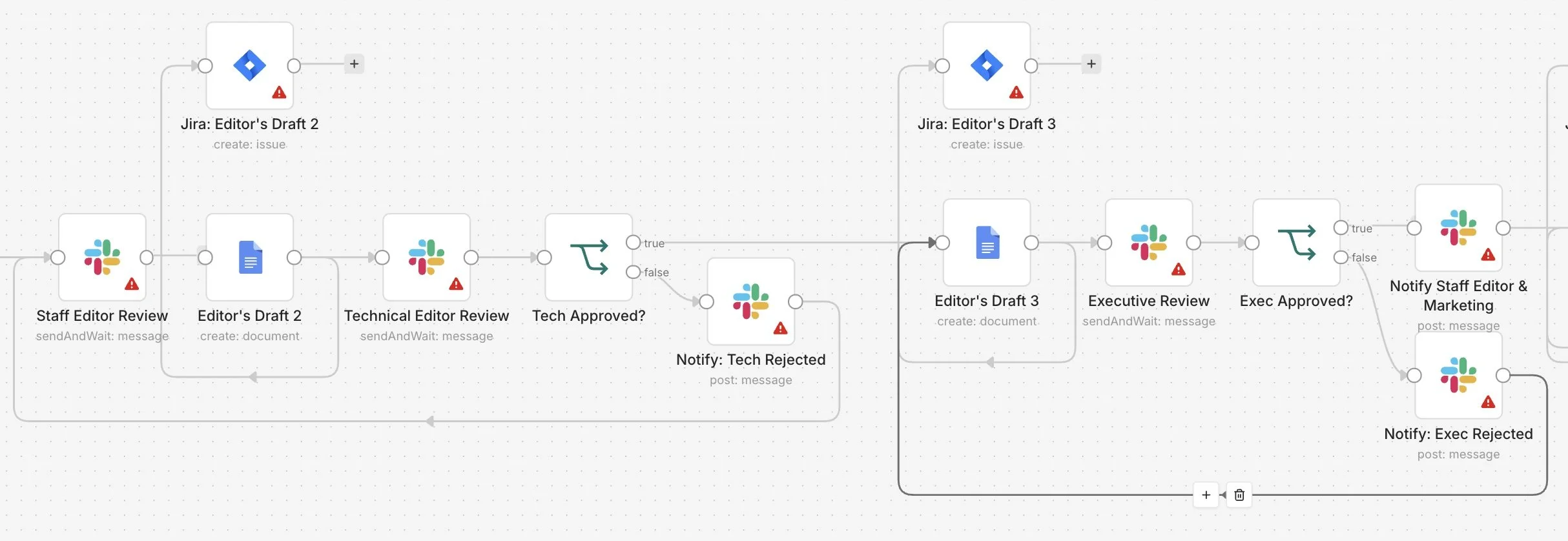
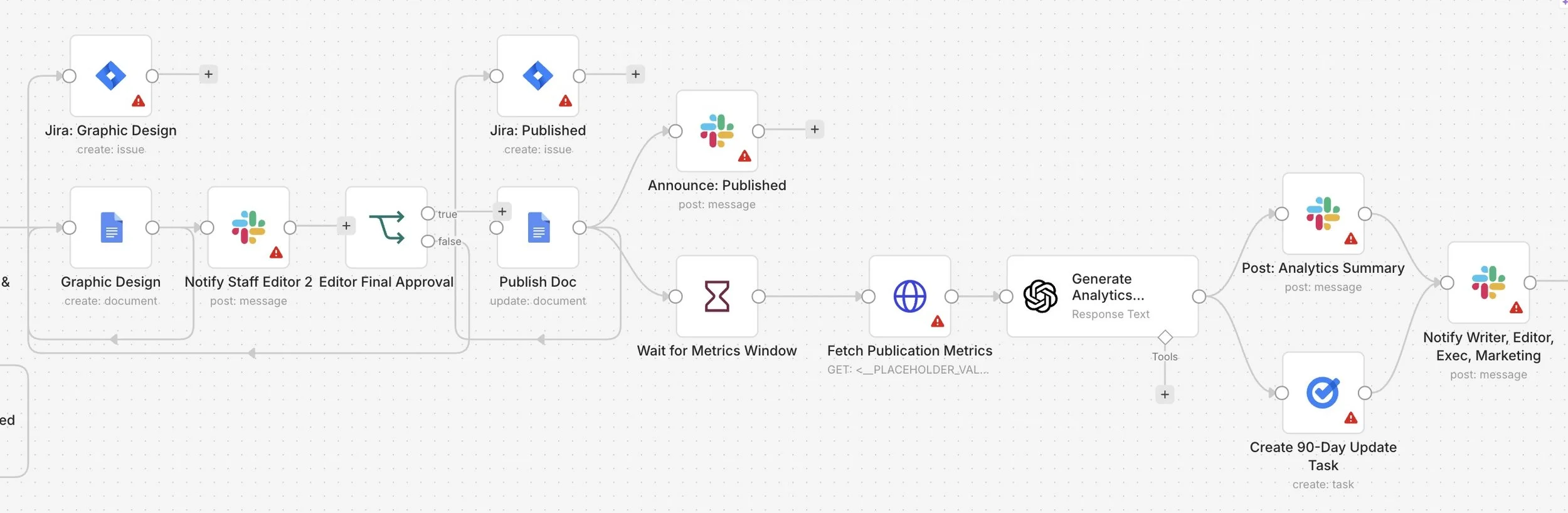
AI-assisted project management: Designed and documented AI-enabled editorial workflows that combine human review with automated quality checks, approvals, and process tracking.
Editorial automation: Built workflow automations using n8n, Jira, and Slack to streamline document routing, status tracking, notifications, approvals, and editorial collaboration.
Content management systems (CMS): Experience working with and organizing content in modern CMS platforms and structured publishing environments, with an emphasis on editorial governance, taxonomy, and workflow.
Editorial operations: Extensive experience with Microsoft Word (Track Changes, comments, document comparison, templates, and styles), Microsoft 365, SharePoint, Confluence, Grammarly, ChatGPT, and Jira.
Collaboration: Worked closely with subject-matter experts and executive stakeholders, rapidly learning new technical domains and adapting to established organizational voice and style.
Process improvement: Identified opportunities to reduce administrative overhead, standardize editorial practices, and improve publication speed without sacrificing quality.
Investment knowledge: Longtime investor with strong interest in financial markets, monetary policy, quantitative investing, and artificial intelligence; adept at learning complex technical topics and communicating them clearly to both specialist and general audiences.
-
American Council of Learned Societies Digital Justice Grant. $100,000 grant to investigate and create digital humanities tools about racist covenants in property deeds in Washoe County. With Christopher von Nagy and Kate Berry. April 2024.
State of Nevada Appropriation, SB368, Lead sponsor Dallas Harris, to investigate and redact racist covenants from property deeds in the State of Nevada, $300,000, split evenly between UNR and UNLV, June 2023.
Scholarly and Creative Activities Grant Project, The University of Nevada, Reno, $5,500, March 2023.
Dimensions Grant, The University of Nevada, Reno, to map racial covenants and better understand racial discrimination in Reno, Nevada, $8,000, May 2023. Principal Investigator.
Dimensions Grant, The University of Nevada, Reno, to map racial covenants and better understand racial discrimination in Reno, Nevada, $8,000, May 2021. Principal Investigator.
Non-Residential Fellowship, Hutchins Center for African & African American Research, Harvard University, March 2018-August 2022.
Hall Center for the Humanities Research Fellowship, Spring 2015.
General Research Fund Grant, The University of Kansas, May 2014.
American Council of Learned Societies, Charles A. Ryskamp Research Fellowship, 2014.
National Endowment for the Humanities Summer Institute for College Teachers, African-American Struggles for Freedom and Civil Rights, The Du Bois Institute, Harvard University, July 2013.
General Research Fund Grant, The University of Kansas, May 2013.
Harry Ransom Center, The University of Texas at Austin, Research Fellow, June 2012.
General Research Fund Grant, The University of Kansas, May 2012.
National Endowment for the Humanities Long-Term Fellowship, The Newberry Library, 2010-2011.
General Research Fund Grant, The University of Kansas, May 2011.
Book Subvention Award, Friends of the Hall Center, The University of Kansas, 2011.
Black Metropolitan Research Consortium Fellowship, The University of Chicago, August 2010.
William S. Vaughn Visiting Fellowship, Robert Penn Warren Center for the Humanities, Vanderbilt University, 2010-2011, declined.
Month-Long Research Grant, The University of Wisconsin-Madison Libraries, July 2010.
Research Grant, Duke University Rare Book, Manuscript, and Special Collections Library, June 2010.
General Research Fund Grant, The University of Kansas, May 2010.
General Research Fund Grant, The University of Kansas, May 2009.
New Faculty General Research Fund Grant, The University of Kansas, May 2008.
Gilder-Lehrman Fellowship, Rare Book and Manuscript Library, Columbia University, June 2007.
Andrew W. Mellon Postdoctoral Fellow, Wesleyan University, Center for the Humanities, 2006 – 2007.
Donald C. Gallup Fellowship in American Literature, Beinecke Library, Yale University, September 2006.
Mellon Postdoctoral Fellowship, Center for the Study of Cultures, Rice University, 2006-2008, declined.
Transnational and Transcolonial Studies Paper Prize, University of California Research Group, 2002.
Carey McWilliams Four-Year Fellowship, UCLA Department of History, 1999 – 2004.
Jacob Javits Fellowship, U.S. Department of Education, 1999 – 2004, declined.
Research Grant, UCLA Center for African American Studies, 2001.
Yearlong Research Mentorship Grant, UCLA Graduate Division, 2001.
Summer Research Mentorship Grant, UCLA Graduate Division, 2000.
Golden Medal in the Humanities, Stanford University, 1996.

-
Praise for The Princess and The Prophet (Beacon Press 2020).
Dorman has a “knack for keeping one amused and amazed”—Harper’s Magazine, 2020.
“exciting new information…a signal contribution—The Wall Street Journal, 2020.
“Dorman does an excellent job of presenting his information in a clear and entertaining manner, making the subject matter so interesting that you can't helped but be pulled into the narrative.” — Qantara.de, 2020.
“A fascinating work of historical reinterpretation.”
—Booklist, Starred Review“A remarkable study.”
—Publishers Weekly“deft and riveting…a prodigious feat of detective work and archival magic. A spectacular book in so many ways.”
—Robin D. G. Kelley, UCLA“A masterful blend of rigorous scholarship and compelling narrative,”
—Michael Muhammad Knight, University of Central Florida.“A superb study. Intelligently conceived, meticulously researched, and splendidly written.”—William M. Tuttle, Jr., The University of Kansas.
“A must-read! Jacob S. Dorman weaves together fascinating and compelling tales.”
—LaShawn D. Harris, Michigan State University.Praise for Chosen People (Oxford UP 2013)
"a masterful (even paradigm-shifting) book…a genuine tour de force."—John L. Jackson, Jr., Provost, The University of Pennsylvania.
"an immense contribution…the research is prodigious, the scope impressive, and his telling is truly dynamic.”—Robin D. G. Kelley, UCLA.
"Chosen People is a bold, compelling history…a novel intervention in scholarly debates of cultural change in the African diaspora, a must- read”—Edda Fields-Black, American Historical Association
"fascinating.”—Cheryl Greenberg, Trinity College
"an engaging study…This significant book makes a valuable contribution to the literature on cultural synthesis and African American history." —The Journal of American History
"refreshing shift…a must-read." —Pneuma
"Dorman's book is an impressive effort to write persuasively and clearly about complexity."—The Journal of Religion
I. Demonstration n8n site for AI-assisted automation of an editorial process.
Below are images from the agentic AI automator n8n showing what an automated, agentic, AI-enabled, human-in-the-loop editorial process could look like for a corporation, with integrations with ChatGPT, Slack, and Jira. You can find a Loom video below for a brief explanation.
II. Demonstration Jira Site for Management of an Editorial Department.
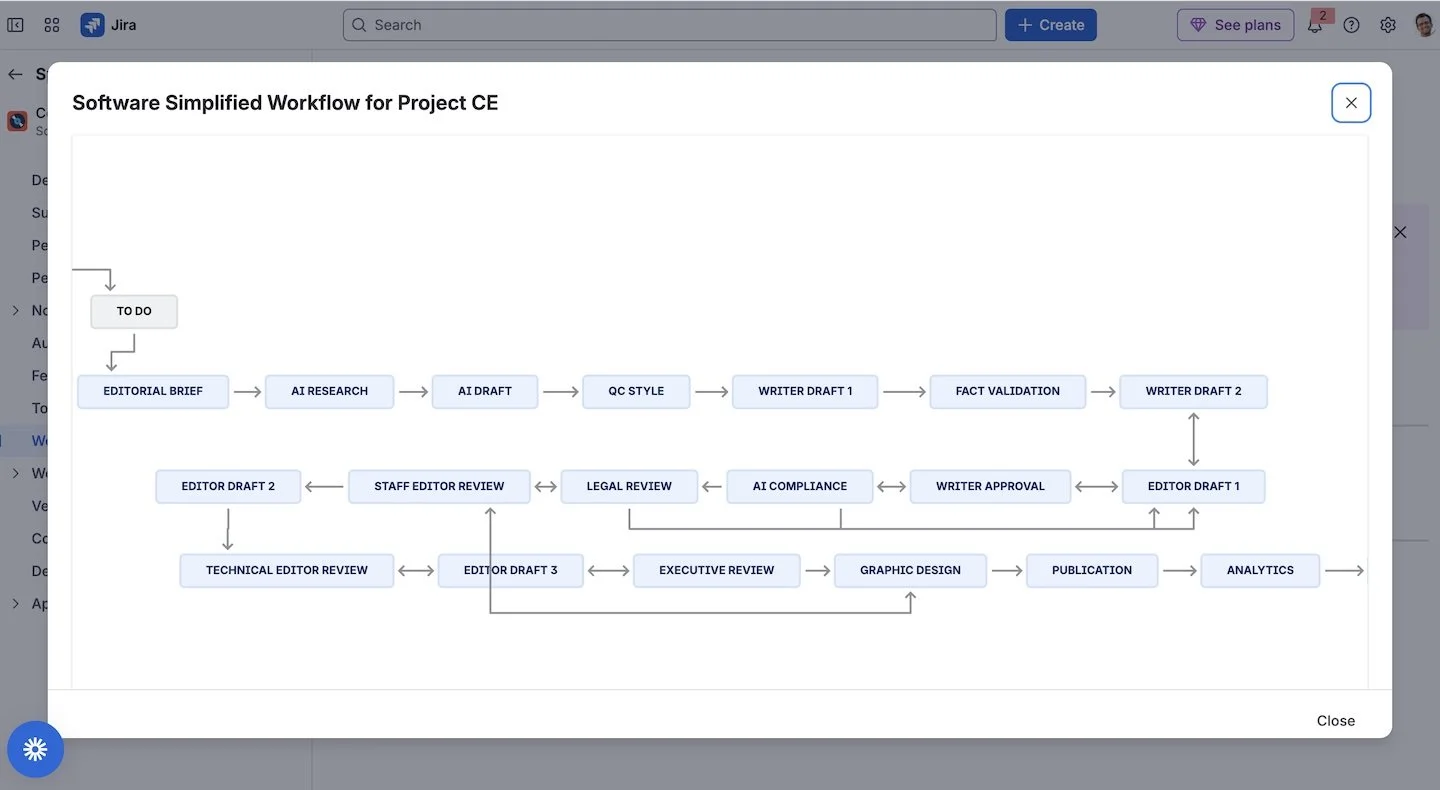
This is a demonstration Jira space I created to show how an editorial department could use project management software to coordinate an entire corporation’s written output, followed by a short explainer video. The workflow in this space matches the workflow in n8n.


III. Demonstration of an LLM-assisted Content Creation Process.
In this exercise, I take a typical quantitative academic paper about machine learning investment strategies, improve the product, and explain my changes and the principles behind them. I use generative AI when it is helpful for introductory and intermediate tasks. I also perform developmental and copyediting with the assistance of AI, but take over the steering wheel when it is time to tune and generate the final product. I am guiding the process; I am in the loop as LLMs and AI grammar checkers work, and I am the independent and sole creative author of the organization, logic, rhetoric, language, phrasing, metaphors, humor, and artistry of the final product.
-
I instructed ChatGPT to find academic papers about machine learning in investing with text that could be improved upon. It returned four choices but had to be steered back on course before finding an appropriate one, below.
Ronen Israel, Bryan Kelly, and Tobias Moskowitz, "Can Machines 'Learn' Finance?," Journal of Investment Management 18, no. 2 (2020): 23–36. (Excerpt pp. 24-25).
So why have we moved to using new terminology to describe old ideas? Above and beyond the marketing angle—machine learning is a sexy name that carries the connotation of bleeding edge Silicon Valley technology—there are at least three substantive reasons for this shift. First, the historical practical usage of statistics was frequently confined to “small” models—those with a handful of input predictor variables (or “features” in ML terminology) and simple, often linear, association rules between those inputs and the output (i.e., dependent variable) of interest. The term “machine learning” has come to serve as a shorthand to signal an explicit interest in “large” models, those with many input variables and/or those allowing for complex nonlinear associations between the inputs and output.
This idea is captured by part (i) of the GXK definition above. In order to learn through experience, the machine needs a representation of what it is trying to learn, which requires a research choice. Machine learning brings an open-mindedness for statistical representations that are richly parameterized and often nonlinear. Such models are of course not new to statistics, so it would be misleading to describe this as a contrast with “traditional” statistics. But it is fair to say that machine learning specializes in this sophisticated end of the model spectrum. Small models are rigid and oversimplified, but have the virtue that they can be used with small data sets. They are also “robust” in the sense that their behavior can be relatively insensitive to reasonable changes in the data. Large and sophisticated models are much more flexible, but can also suffer from poor outof-sample performance when they overfit noise in the system. Researchers turn to models like these when they believe the benefits from more accurately describing the complexities of real-world phenomena outweigh the costs of potential overfit. Part (i) of this definition also points out that the primary objective of machine learning is to generate accurate predictions. As emphasized by Breiman et al. (2001), its focus on maximizing prediction accuracy in the face of an unknown data model is the central differentiating feature of machine learning from the traditional statistical objective of estimating a known data-generating model and conducting hypothesis tests.
Second, machine learning seeks to choose a preferred model from a “diverse collection” of candidate models. Again, this idea has a long history in statistics under the heading of “model selection” and therefore is not a new contribution of machine learning. But the process of searching through many models to find the best performer is characteristic of essentially all machine learning methods—it is closely connected with what machine learners call model “tuning.” Of course, looking at multiple models and selecting the top performers in-sample mechanically leads to overfit and poor out-of-sample performance. Because of this, the model search process is always accompanied by so-called “regularization” techniques and methods for identifying models that are likely to perform best out-of-sample. Regularization is a blanket term for constraining the size of a model. An optimal model is a “Goldilocks” model. It is large enough so that it can reliably identify the true and potentially complex predictive relationships in the data, but not so flexible that it overfits and suffers out-of-sample. Regularization methods encourage smaller models, and make sure that a richer model only gets selected if it is likely to give a genuine boost to out-of-sample prediction accuracy. A cornerstone method in the model selection process is cross-validation, in which the researcher simulates out-of-sample tests in historical data and picks models that would have performed best in these “as-if” out-of-sample scenarios. Element (ii) of our machine learning definition describes refinements in implementation that emphasize reliable out-of-sample performance in order to explicitly guard against overfit.
-
Note that this version is greatly condensed and uses much simpler language. It is also re-sequenced. However, it is still quite long and robotic; clearly written by AI.
Why call it machine learning?
The term machine learning describes ideas that overlap substantially with traditional statistics, so why has it become a distinct field? Part of the answer is marketing: the phrase evokes cutting-edge Silicon Valley technology. But the distinction reflects several meaningful changes in how researchers build predictive models.
The first difference concerns scale. Traditional statistical models were often designed around a small number of predictors and relatively simple relationships between those inputs and the outcome being predicted. Machine learning expands this approach by allowing researchers to analyze much larger sets of variables and more complex, nonlinear relationships.
This does not mean machine learning replaces statistics. Many of its techniques have deep roots in statistical research. Rather, machine learning extends statistics toward the more flexible end of the modeling spectrum. Its central advantage is that it allows researchers to search for complex patterns without specifying those relationships in advance.
That flexibility comes with a tradeoff. Smaller models require stronger assumptions, but they are often more stable when data are limited. Larger models can capture more complicated relationships, but they also risk identifying patterns that exist only in historical data rather than in the underlying system. This problem, known as overfitting, occurs when a model learns noise instead of meaningful signals.
Researchers therefore seek a balance: models flexible enough to identify genuine predictive relationships but constrained enough to perform well on new data. Machine learning emphasizes this balance by focusing not only on developing models but also on testing and selecting among many possible models.
A second defining feature of machine learning is systematic model selection. Traditional statistics has long included methods for comparing alternative models, but machine learning places greater emphasis on searching across large collections of possible models and identifying those that perform best. Because searching among many models can itself create misleading results, machine-learning methods rely heavily on techniques such as regularization and cross-validation.
Regularization limits unnecessary complexity, preventing models from becoming more elaborate than the data can support. Cross-validation tests whether a model that performs well on historical data is likely to remain effective on new information. Together, these methods help researchers distinguish genuine predictive power from patterns that appear meaningful only by chance.
-
Next, I checked ChatGPT’s rationale for its editorial decisions. It responded:
This edit is guided by a simple editorial principle: readers should grasp the author's central argument before they are asked to absorb its technical details. The original passage contains a clear and persuasive thesis. To whit: machine learning is best understood as an extension of statistical modeling rather than a departure from it. However, that argument is difficult to find because of all the definitions, qualifications, and technical explanations.
My revisions preserve the authors' substantive claims while reorganizing the discussion around the reader's cognitive experience. The revised version introduces the central argument first, then develops it through a logical progression from differences in model complexity, to the tradeoffs those differences create, to the techniques machine learning uses to manage those tradeoffs.
Throughout, I replace abstract phrases with multiple nouns with more direct verbs. I also seek to reduce unnecessary jargon, eliminate repetition, and make implicit relationships explicit. The goal is not to simplify the underlying ideas, but to make their logical structure immediately visible so that readers can devote their attention to understanding the argument rather than decoding the prose.
-
Everything I have done so far are forms of research and prewriting, just like I would do if I were conducting research, taking notes on scholarship, and organizing my thoughts before writing anything. Now, I craft my own version, with wit, rhetoric, logic, and style that are distinctly human.
Investing with Stats and Machine Learning
A Summary of an excerpt of: Ronen Israel, Bryan Kelly, and Tobias Moskowitz, "Can Machines 'Learn' Finance?," Journal of Investment Management 18, no. 2 (2020): 23–36.
by Jacob S. Dorman, Ph.D.
Many machine-learning investment techniques rely on statistical methods; they do not replace them. To the contrary, they use statistics to find complex patterns in mountains of financial data. In other words, they don’t just find the needle in the haystack; they analyze the position of every piece of hay. Using machine learning to expand statistical techniques enables analysis of much larger and more complex datasets in a greater variety of ways. It enables statistics to operate with greater flexibility, allowing researchers to let the AI choose methods and patterns rather than determining those choices in advance.
Frankly, another factor we speak of “machine learning” or “AI” is marketing: those phrases are punchier and have greater commercial cachet than “computer-assisted advanced statistics.”
But applying stats and machine learning to investing is not without peril; searching for models can itself produce misleading results, so researchers use model-tuning techniques known as “regularization” and “cross-validation”—kind of like using various methods to “check the math” of LLM-generated computer code. Regularization limits unnecessary complexity, keeping models from becoming more elaborate than the data supports. Cross-validation checks whether a model that performs well on past data will still be effective on new information. Together, these methods help researchers distinguish useful patterns from those that might seem predictive but are actually just the result of chance events. The goal is to find the “Goldilocks” model: just right.
After all, not all machine learning investment models are created equal. Smaller models require more assumptions, but they are often preferable to large models when there isn’t much data. On the other hand, larger models can find more complex patterns in the data, but they also risk “overfitting,” which happens when a model cannot distinguish between “noise” and meaningful patterns. As a result, researchers must balance the size, sophistication, and flexibility of their models to find genuinely predictive patterns. In other words, models need to analyze a bale of hay and adapt so they don’t go haywire when they try to make sense of a barnful of data. As a result, researchers carefully develop and test many possible models. Humans need to be in the loop—the hay is not going to bale itself!
-
Throughout this process, I used generative AI as a researcher and thought partner, not as an authoritative writer. I delegated the intermediate tasks that AI performs efficiently—finding articles, summarizing them, and generating alternative drafts—while making all substantive editorial decisions myself.
The finished piece differs substantially from the AI drafts. I reorganized the material into a more logical structure, removed repetition, condensed 619 words into 366, and relied on rhetorical techniques that remain difficult for LLMs to produce consistently: extended metaphor, alliteration, subtle humor, rhythm, and carefully sequenced paragraphs. The recurring hay metaphor, for example, grew out of my own memories of stacking hay bales on a friend's farm decades ago—an experience that provided sensory details and emotional texture unavailable to an AI system. I also restored several effective metaphors from the original text that the LLM had discarded because I judged their communicative value to outweigh their complexity.
I revised the passage repeatedly, printed it for another round of editing, and then used Grammarly and Microsoft Word as final quality-control tools. Grammarly was valuable for catching grammatical issues and overlooked typos, but I accepted relatively few of its stylistic suggestions, making far more substantive revisions on my own. Like any tool, AI is most useful when paired with expert human judgment.
This project reinforced my view that AI works best as an accelerator rather than a replacement for experienced editors. It can dramatically speed research, brainstorming, and early drafting, but effective writing still depends on judgment, structure, voice, lived experience, and rhetorical craftsmanship developed over decades. When I ran the finished version through Grammarly's AI detector, it identified none of the prose as AI-generated—exactly the outcome I was aiming for.
IV. Sample Writing for Popular Audiences.
These are examples of brief op-eds written for popular audiences, intended to inform and persuade.
V. Sample Grant Writing
I have authored 24 successful grant and fellowship applications. This sample is a successful application I wrote for a grant from the American Council of Learned Societies to study and map the incidences of racist covenants barring home occupancy by people of color in Washoe County, Nevada, a common practice from 1900 to 1968. From 2020-2025, I founded the project, built a 12-person board of faculty and community members, and secured $350,000 in funding, ran a competitive hiring process for student workers, and built a team of ten students and three main faculty members.
VI. My Blog about writing.
I have thought a lot about what makes for good writing, how to help others become better writers, and the uses of AI in writing. I have collected some of those thoughts in my blog.
VII. My Company, Advantage Editorial
Over the last two decades, I have written and edited more than 600,000 words. I started Advantage Editorial to help subject matter experts communicate their ideas to wide audiences with precision and elegance.